
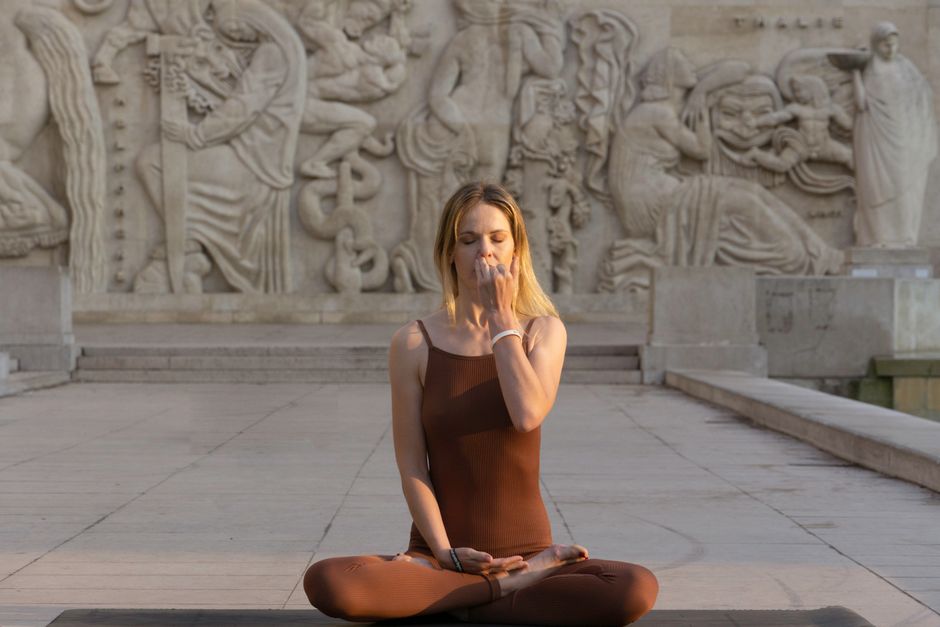
Anxiety lives somewhere specific in the body. Most people, when they slow down enough to locate it, find it without much difficulty. For some, it's the chest, a tightness or heaviness, sometimes a fluttering. For others, it's the throat: a constriction, a difficulty swallowing, the feeling of words that won't quite come. The gut is extremely common: the hollow feeling before a hard conversation, the rolling nausea of waiting for a result, the urgency that arrives without a clear physical cause. Some people feel it in the shoulders, already lifted and braced. Others in the jaw, quietly held. Others in the hands, which somehow know before the mind does.
Understanding where anxiety lives in your body, and learning to work with it there, is a different and often more effective approach than trying to address it at the level of thought. Because by the time anxiety shows up as thought, it's already been present in the body for a while. The thought is often the last thing to arrive.
Why the body matters here
The somatic marker hypothesis, developed by neuroscientist Antonio Damasio, proposes that the body generates emotional signals, physical sensations, that precede and inform conscious emotional experience. In other words, the body is not a passive carrier of emotions generated in the mind. It is part of the generation of emotional experience itself.
This is why approaches to anxiety that focus purely on changing thoughts, while useful, often don't get to the root of the experience. The root is somatic. And the most reliable path to changing an emotional state runs through the body.
Bessel van der Kolk's work, explored in The Body Keeps the Score, traces how trauma and chronic stress leave imprints in the body's tissues and nervous system that conscious thought alone cannot fully access or resolve. The body holds what the mind has learned to manage. And the body needs its own kind of attention.
The problem with avoiding the physical sensation
The instinct, when anxiety produces an uncomfortable physical sensation, is to move away from it. To distract, to suppress, to do something that shifts attention somewhere else. And in the short term, this works, the sensation recedes, the urgency lessens.
The difficulty is that avoided sensations tend to return. And often, the anxiety around the sensation, the fear of the physical feeling itself, compounds over time. People develop anxiety about the anxiety: they begin to fear the chest tightness, which produces more chest tightness, which is experienced as confirmation that something is wrong.
What somatic therapy and body-based practice consistently demonstrate is that approaching a physical sensation with curiosity rather than avoidance, staying with it long enough to understand what it is and what it needs, rather than treating it as a threat to be escaped, tends to reduce both the intensity and the fear around it.
The sensation, when you turn towards it with deliberate attention, is usually more tolerable than the anticipation of the sensation. It has a texture, a quality, a boundary. It is something specific, not an unlimited threat.
A practice for working with it
Find the sensation in your body, wherever anxiety currently lives for you. If nothing is present right now, you can bring to mind something mildly anxious and notice what arises.
Once you've located it, get curious. Where is it exactly, what part of the body? Does it have a size? A shape? A texture or quality, is it heavy or tight or fluttering or sharp or dull? Does it have a temperature? Does it move or is it still?
Stay with it without trying to change it. You're not trying to dissolve it or push through it. You're just letting it be present while you look at it clearly.
Notice what happens. Often, not always, but often, the act of bringing calm, curious attention to a sensation changes it. It may soften. It may shift. It may reveal something it needed to communicate: a need for rest, a boundary that hasn't been named, an emotion that hasn't been acknowledged.
This is not a technique for acute panic. It is a practice for building your tolerance for the physical experience of anxiety over time, so that the sensation itself becomes less frightening, which is one of the most effective things you can do for long-term anxiety management.
The role of breath
Breath is the most direct bridge between the conscious and unconscious nervous system, and it is the single most available somatic tool for working with anxiety. When anxiety narrows the breath, shortening the inhale, creating chest-only breathing, increasing rate, deliberately working with the breath has direct physiological consequences.
A slow exhale activates the parasympathetic nervous system. It signals to the body that the threat is easing, even when the circumstances haven't changed. This is not a trick, and it is not about bypassing the anxiety. It is about providing the nervous system with accurate information: the body is not in immediate danger. The long exhale is the body's own safety signal.
You don't need a formal practice to use this. The next time anxiety is present, simply pause and let the exhale be longer than the inhale. Three or four times. Notice what, if anything, shifts.
Learning to bring attention to the body, not as a problem to be solved but as a source of information and, ultimately, as a place that can be made safe, is some of the most important work available for anxiety. It happens slowly and with practice. But it is available to almost everyone.