
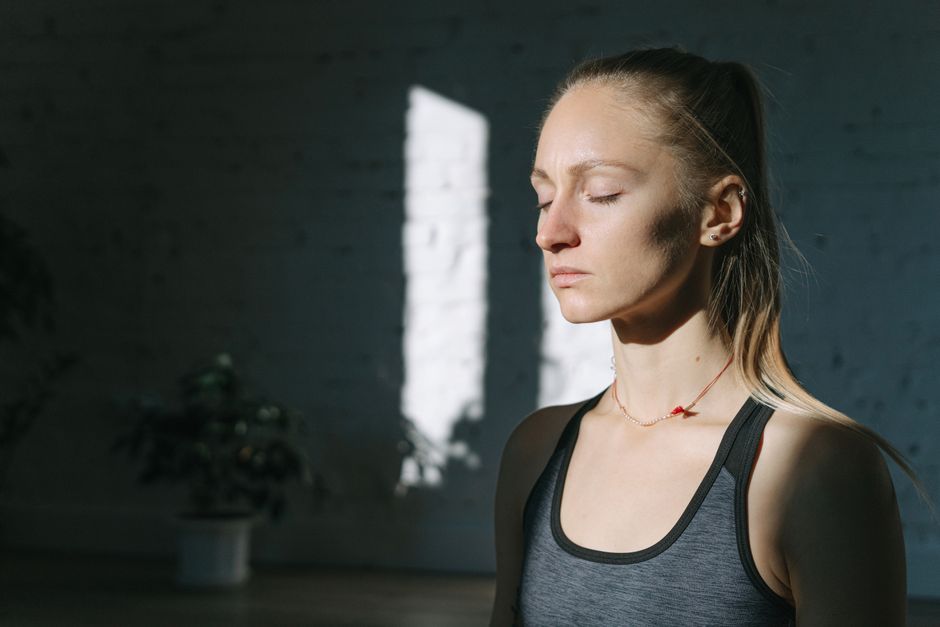
Learn how to practice box breathing, known in yoga as Samavritti Pranayama, and discover how to deepen your practice by progressively adjusting the count and rhythm.
What Is Box Breathing and Samavritti Pranayama?
Box breathing, known in the yogic tradition as Samavritti Pranayama, is one of the most elegant and accessible breathing practices available to us. The word Samavritti comes from Sanskrit: sama, meaning equal, and vritti, meaning movement or fluctuation. Together, they describe a breath that moves in perfectly equal parts, a square, or a box.
The technique involves four phases of equal duration: inhale, hold, exhale, hold. Each phase mirrors the others, creating a rhythmic, symmetrical cycle that profoundly affects the nervous system. It is used by everyone from Navy SEALs and athletes to meditators and therapists, and for good reason. The science behind it shows measurable reductions in cortisol, improvements in heart rate variability, and a shift from sympathetic (fight-or-flight) to parasympathetic (rest-and-digest) nervous system dominance.
Whether you are brand new to breathwork or looking to deepen an existing practice, Samavritti offers a clear, structured path forward.
How to Practice Box Breathing: The Foundation
Before you begin, find a comfortable seated position, either in a chair with your feet flat on the floor or cross-legged on a cushion. Sit tall enough that your chest feels open, but relaxed enough that your shoulders are not raised. Close your eyes if that feels comfortable, or soften your gaze downward.
Here is the basic structure using a 4-count, which is the ideal starting point for most people:
Inhale slowly through the nose for a count of 4.
Hold the breath in (top of the inhale) for a count of 4.
Exhale slowly through the nose for a count of 4.
Hold the breath out (bottom of the exhale) for a count of 4.
That completes one full round. Repeat this cycle for a minimum of 4 to 6 rounds to begin noticing the effects, or practice for a set time, 5 minutes is a wonderful starting point.
A few important notes for beginners: the breath should feel smooth and controlled, never forced or strained. If a count of 4 feels too long on any phase, that is a clear signal to shorten the count. There is no virtue in pushing through discomfort in breathwork; ease and sustainability are the hallmarks of a good session. Also, keep the breath nasal throughout if possible, as nasal breathing filters, warms, and humidifies the air, while also engaging the diaphragm more effectively.
Using a Mental Cue to Stay Present
One of the subtle challenges of box breathing, especially when you are learning, is keeping the mind from wandering between counts. A simple technique is to visualise the box itself as you breathe. Imagine tracing each side of a square:
As you inhale, trace the left side upward.
As you hold at the top, trace the top side to the right.
As you exhale, trace the right side downward.
As you hold at the bottom, trace the bottom side back to the left.
This simple visualisation anchors attention to the breath cycle and gives the mind a gentle object to focus on, making it an excellent entry point into meditation as well as breathwork. Over time, the visualisation may become unnecessary as the rhythm becomes more internalised, but it remains a tool when the mind is particularly busy.
Letting the Practice Develop: Evolving Your Count
Once you feel genuinely comfortable with the 4-4-4-4 rhythm, meaning you can sustain it for 10 minutes without strain and without losing the smoothness of the breath, you are ready to let the practice grow. This is where Samavritti becomes a truly rich, long-term practice.
The guiding principle is simple: increase gradually, in equal increments, and only when ready. Because Samavritti means equal movement, all four phases always remain the same count as each other. You are not elongating one phase at the expense of another; you are expanding the entire square.
A natural progression might look like this:
Weeks 1–2: 4-4-4-4 — building familiarity and comfort.
Weeks 3–4: 5-5-5-5 — a subtle but noticeable increase in depth.
Month 2: 6-6-6-6 — the breath begins to feel more meditative and internally expansive.
Month 3 onward: 7-7-7-7 or 8-8-8-8 — practised meditators and experienced breathwork students may comfortably work in this range.
It is worth noting that the quality of each count matters far more than the number. A smooth, conscious 4-count is infinitely more valuable than a strained 8-count. Let the body lead this progression; some people may stay happily at 5 or 6 for months or years, and that is not a limitation but a sign of honest, sustainable practice.
Working with a Slower Counting Pace
Another way to deepen without increasing the count number is to slow down the pace of the count itself. Instead of counting at roughly one beat per second, you might slow to a beat every 1.5 or 2 seconds. A 4-count at this slower tempo becomes the equivalent of a 6 or 8-second phase, creating a significantly longer and more spacious breath cycle without requiring you to change the number you are counting to. This approach can feel more natural and organic for many practitioners.
Adding Kumbhaka: The Art of the Retention
In yogic tradition, the breath retentions, both at the top of the inhale and the bottom of the exhale, are called Kumbhaka, meaning pot or vessel. The analogy is beautiful: at each retention, you become a still vessel, holding the energy of the breath. As your practice matures, you may find the retentions become the most potent and interesting phases of the cycle, moments of genuine stillness where body and mind settle together. Give them the same care and attention as the inhale and exhale themselves.
When and How Often to Practice
Consistency matters far more than duration. A 5-minute daily practice will produce more lasting benefits than an occasional 30-minute session. That said, Samavritti is versatile enough to be practised in many contexts:
Morning: Sets a calm, centred tone for the day ahead.
Before a stressful event: Regulates the nervous system quickly and effectively.
Before meditation: Prepares the mind beautifully by settling mental chatter.
Before sleep: Helps transition the body out of wakefulness and into rest.
Avoid practising immediately after a heavy meal, and if you ever feel lightheaded or anxious during the practice, release the count and return to natural breathing. Always prioritise ease over effort.
Conclusion: A Practice That Grows With You
What makes Samavritti Pranayama so remarkable is its scalability. It meets you exactly where you are, accessible enough for a complete beginner on day one, deep enough to occupy an experienced practitioner for a lifetime. The equal rhythm of the breath becomes a mirror for equanimity in daily life: the capacity to stay steady and present, whether you are at the top of the inhale or the bottom of the exhale.
Start with a 4-count today. Practice it honestly and consistently. Let the practice teach you when it is ready to expand. The box is simple, but what it opens up inside you is anything but.
Ready to begin? Set a 5-minute timer, find a quiet seat, and trace your first box. Notice what shifts in your body, your breath, your mind. That noticing is the beginning of everything.