
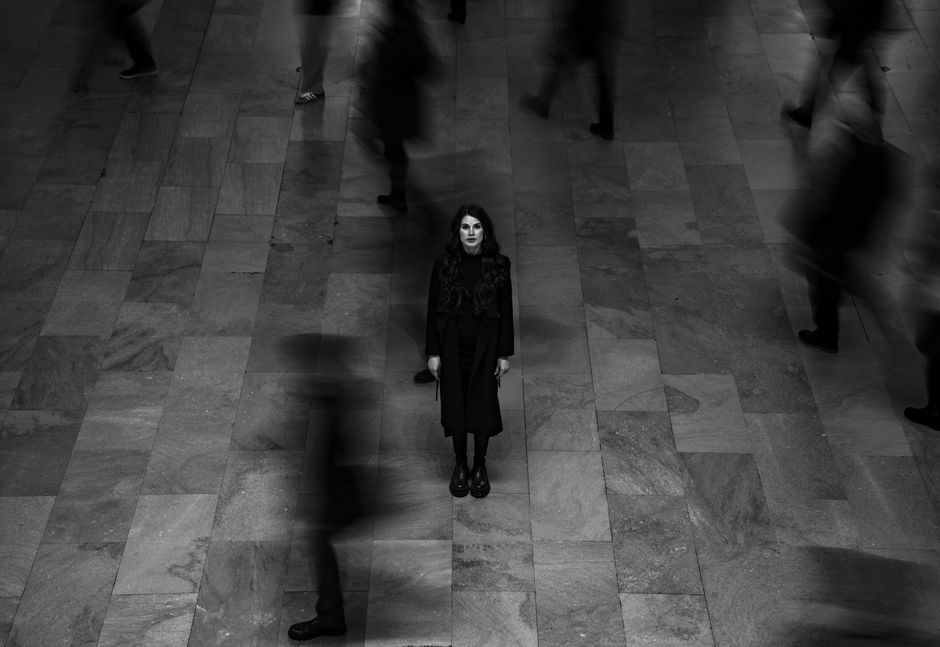
There's a particular kind of exhaustion that comes from trying to be the right amount of a person. Not too needy. Not too distant. Not too much. Not too quiet. Not too intense. Not too easy to ignore. It's an impossible calibration, and most of us have been attempting it for so long that we've stopped noticing we're doing it.
But your body notices. Your body is keeping the score of every moment you made yourself smaller to fit, every time you swallowed something you needed to say, every version of yourself you put away because the room didn't seem safe enough to let her out.
That's what this feeling is. Too much and not enough at the same time isn't a contradiction; it's a description of what it feels like to be caught between an old shame story and a self that is trying, quietly and persistently, to exist.
Where does this feeling come from
This particular combination, too much in one direction, not enough in another, almost always has roots in early experience. The child who was told she was dramatic, who learned that her emotional responses were inconvenient, who got the message, directly or through the environment, that a quieter, smaller, more manageable version of her would be more loved.
Or the child who tried to take up less space and found that even less wasn't enough, that the moving goalposts of other people's needs could never actually be met, and that no amount of shrinking produced the safety she was looking for.
Both experiences leave the same residue: a nervous system that has learned to scan the room before it decides how much of you is safe to bring in. A body that is always, at some level, negotiating.
What it feels like in the body
This isn't primarily a thought. It arrives in the body first, the way all emotions do. It might be a tightness in the throat before you speak. A held breath in a group. A collapse through the chest when someone doesn't respond the way you hoped. A sudden smallness that arrives without warning in the middle of a room full of people who seem to be taking up space without any apparent effort.
It might also arrive as its opposite: a kind of overshooting, saying more than you meant to, being louder than feels right, filling the space in a way that you later feel embarrassed by. Both the shrinking and the overshooting are the nervous system trying to find the right amount, and not quite managing it, because "the right amount" was never a real thing in the first place. It was a moving target that somebody else defined.
What this isn't
This feeling isn't evidence that you are actually too much. Or actually not enough.
It's evidence that you learned, in an environment with its own unmet needs and limitations, that your natural way of being needed to be managed before it could be offered. That learning was adaptive then. It helped you belong. It kept you safe. It was intelligent.
It's just not serving you anymore.
What actually helps
Not performing the right amount better. Not getting more skilled at the calibration. What helps is the slow, patient work of learning that your natural self is not a problem to be solved.
This is not a quick fix and we need to be honest about that. It's a practice of noticing, of catching the moment before the shrinking or the overshooting happens, of asking what you actually need rather than what would be most acceptable, and of building, incrementally, the evidence that the unedited version of you is not only survivable but worth showing up as.
It starts with the body, because that's where the pattern lives. A breath before you speak. Feel your feet before you walk into a room. Noticing the held quality in your chest and letting a little of it go, not because you have to perform relaxation but because the tension was protecting you from something that isn't actually threatening you right now.
And it continues with the kind of self-compassion that isn't about positive affirmations. It's about meeting the part of you that is exhausted from trying to be the right amount, and telling her, honestly, that she can stop. [Self-compassion is not self-pity →]
That's the work. Not arriving at some perfectly calibrated version of yourself. Just gradually, undeniably, taking up the space that was always yours to take.
If you're in one of those moments right now, the Contemplations app has a practice called After Something Hard that was built exactly for this, not to fix anything, just to stay with yourself while the feeling moves through. [Explore the Contemplations app →]