
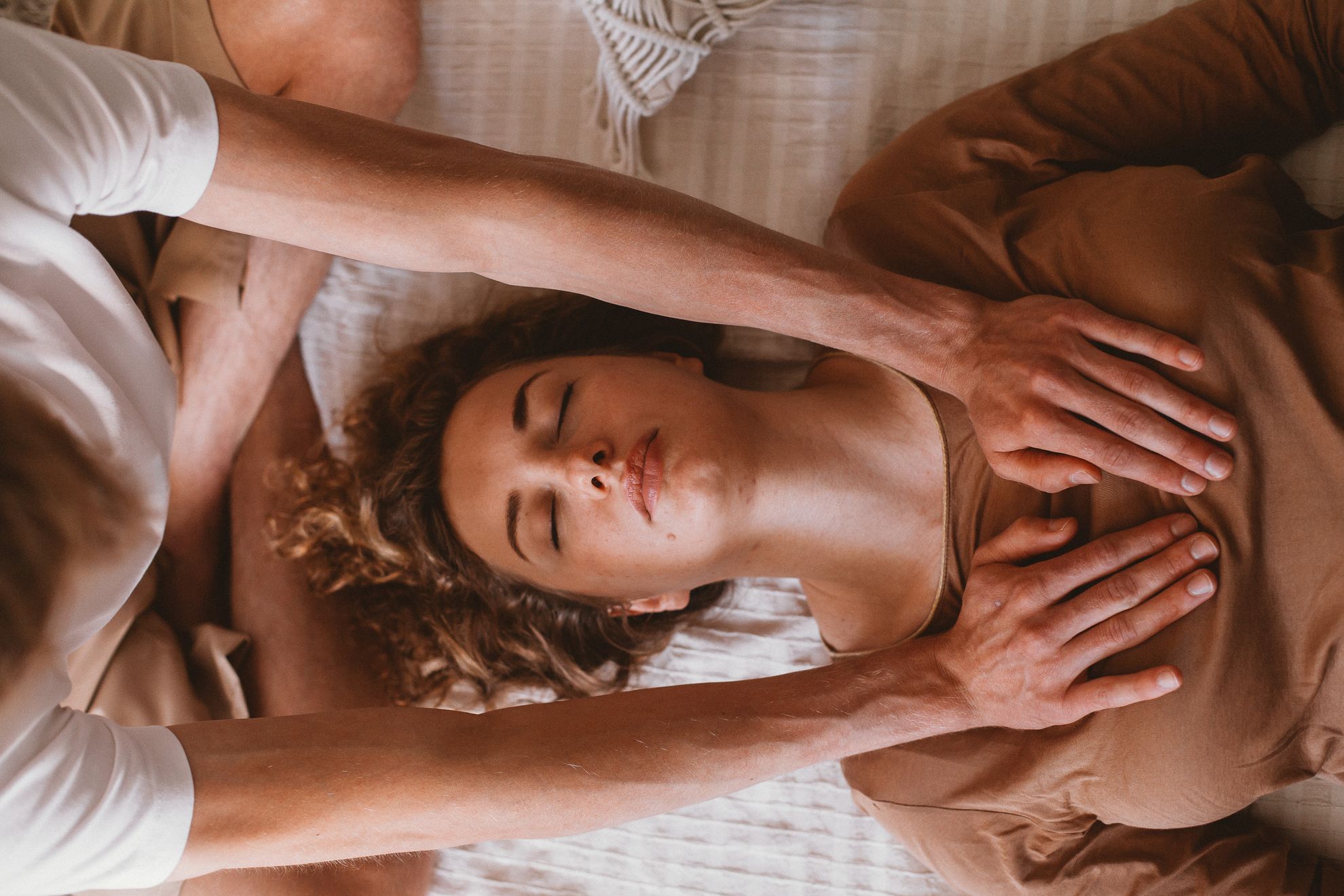
The first time I experienced Yoga Nidra, I was in a training, horizontal on a mat with an eye pillow over my face, and I was fairly certain I was about to fall asleep and snore in front of twenty people. I didn't. What happened instead was something I didn't have language for at the time: a kind of deep, aware stillness that felt more restful than most sleep I'd had in years, and yet I was definitely awake, because I could hear everything the teacher was saying.
That paradox, awake but deeply resting, is exactly what yoga nidra is, and it's also why it's one of the most interesting practices I've encountered in terms of what it actually does to the nervous system.
What is yoga nidra?
Yoga Nidra means yogic sleep in Sanskrit. It's a guided practice, done lying down, in which the student or participant is led through progressive stages of relaxation while maintaining a thread of conscious awareness. The goal is not sleep, even though the body and brain states it produces share some characteristics with the early stages of sleep. And it's very common for people to fall asleep.
The practice originates in the ancient tantric tradition and was systematised for modern practitioners primarily by Swami Satyananda Saraswati in the mid-twentieth century. His system involves a structured sequence: physical relaxation, breath awareness, rotation of consciousness through the body, pairs of opposite sensations, visualisation, and a return to full wakefulness. Different lineages and teachers have their own variations, but the underlying principle is consistent: guide the participant to the hypnagogic threshold, the liminal state between waking and sleeping, and hold them there.
What happens in the brain and body during Yoga Nidra?
In ordinary waking life, the brain is predominantly in a beta wave state, associated with active thinking, problem-solving, and external focus. In Yoga Nidra, the brain moves through alpha waves, associated with relaxed alertness and creative thinking, into the theta wave state that characterises the early stages of sleep and deep meditation, and sometimes briefly touches delta, the wave state of deep, dreamless sleep.
This is significant because the theta state is associated with enhanced neuroplasticity, the brain's ability to form new connections and update existing patterns. It's the state in which we're most receptive to new learning and in which deeply held patterns, including those associated with stress, anxiety, and habitual nervous system responses, are most available to be shifted.
Research on Yoga Nidra is still developing, but the early findings are consistent with this. Studies have shown reductions in cortisol, improvements in sleep quality and onset, reductions in anxiety and stress symptoms, and improvements in heart rate variability with regular practice. A 2020 study published in the International Journal of Yoga found significant improvements in both sleep quality and psychological wellbeing in participants practising Yoga Nidra regularly over eight weeks.
What makes it particularly interesting for nervous system regulation is that it produces deep rest without requiring the practitioner to actually fall asleep. This means people who struggle with sleep onset, with racing minds, with an inability to fully relax, can access a state of genuine physiological rest even when sleep itself isn't available. The body doesn't know the difference, on a hormonal and cellular level, between deep yoga nidra and the early stages of sleep. The repair and restoration happen either way.
The Sankalpa: why yoga nidra is more than rest
One of the distinctive elements of traditional Yoga Nidra is the sankalpa, a short, positively framed intention or resolve planted in the mind at the beginning and end of the practice, when the nervous system is most receptive.
The timing is deliberate. In the hypnagogic state, the critical, analytical mind is quiet, and the deeper layers of the psyche are more accessible. A sankalpa introduced at this moment is understood to land more deeply than an intention held in ordinary waking awareness. Over time, with repetition, the sankalpa is said to take root in the unconscious and begin to shape behaviour and orientation from below the level of conscious thought.
You don't need to approach this metaphysically to find it useful. The neuroscience of neuroplasticity supports the basic principle: the brain is more malleable and more receptive to new patterns in certain states, and the theta state Yoga Nidra produces is one of them.
Who is Yoga Nidra for?
Yoga Nidra is one of the most accessible practices I know, because it requires nothing from the participant except the willingness to lie down and follow a voice. You don't need to be able to meditate. You don't need to be able-bodied. You don't even need to be particularly relaxed when you begin. The practice does the work of taking you there.
It's particularly well-suited to: people who find sitting meditation difficult or frustrating, people with anxiety or racing minds that interfere with sleep, people who are exhausted but find it hard to actually rest, people recovering from burnout or chronic stress, and anyone who wants a practice that is genuinely effortless and immediately accessible.
One note: it's common to drift into actual sleep during yoga nidra, especially when you're tired. This is fine. The body is taking what it needs. Over time, with regular practice, the capacity to stay in that aware, resting state tends to develop naturally.