
Every yoga class I loved as a student, truly loved, the kind where you roll up your mat a little changed, had one thing in common. A story.
Not the anatomical kind ('now we're going to create external rotation in the hip socket'). The ancient kind. The kind where a teacher would begin with: there is a story about...
And something in the room would settle. Everyone would shift slightly on their mats. A collective leaning in.
More than gods to worship
I came to the Hindu deities slowly, the way you come to most things that matter. Not through study, exactly. Through resonance.
The idea that struck me, and has never really left, is that these deities are not primarily beings to worship. They are archetypes. Stories about the forces that live inside every human being.
Saraswati, the goddess of knowledge, art, music, and wisdom, is not just a deity to pray to before an exam. She is the part of you that creates. That reaches for expression. That needs beauty the way the rest of you needs food.
When I was moved in a women's circle by an invocation of Saraswati many years ago, and again, unexpectedly, on retreat in Thailand in 2025. It wasn't because something outside of me had arrived. It was because something inside of me had been recognised.
Saraswati and the moment of being seen
There is a particular quality to encounters with Saraswati that I've noticed across the years. She tends to arrive in places of creation and community. In circles. In rooms where women are giving themselves permission to know things and make things and say true things out loud.
She doesn't announce herself loudly. It's more of a quiet recognition, like coming across a word in another language that describes something you've always felt but never been able to name.
I've carried her with me since that first circle. She has a place in my teaching space. Her image is among the pictures I've placed in my meditation room, the faces that, for reasons I can't always explain, speak to me.
And then there is Hanuman
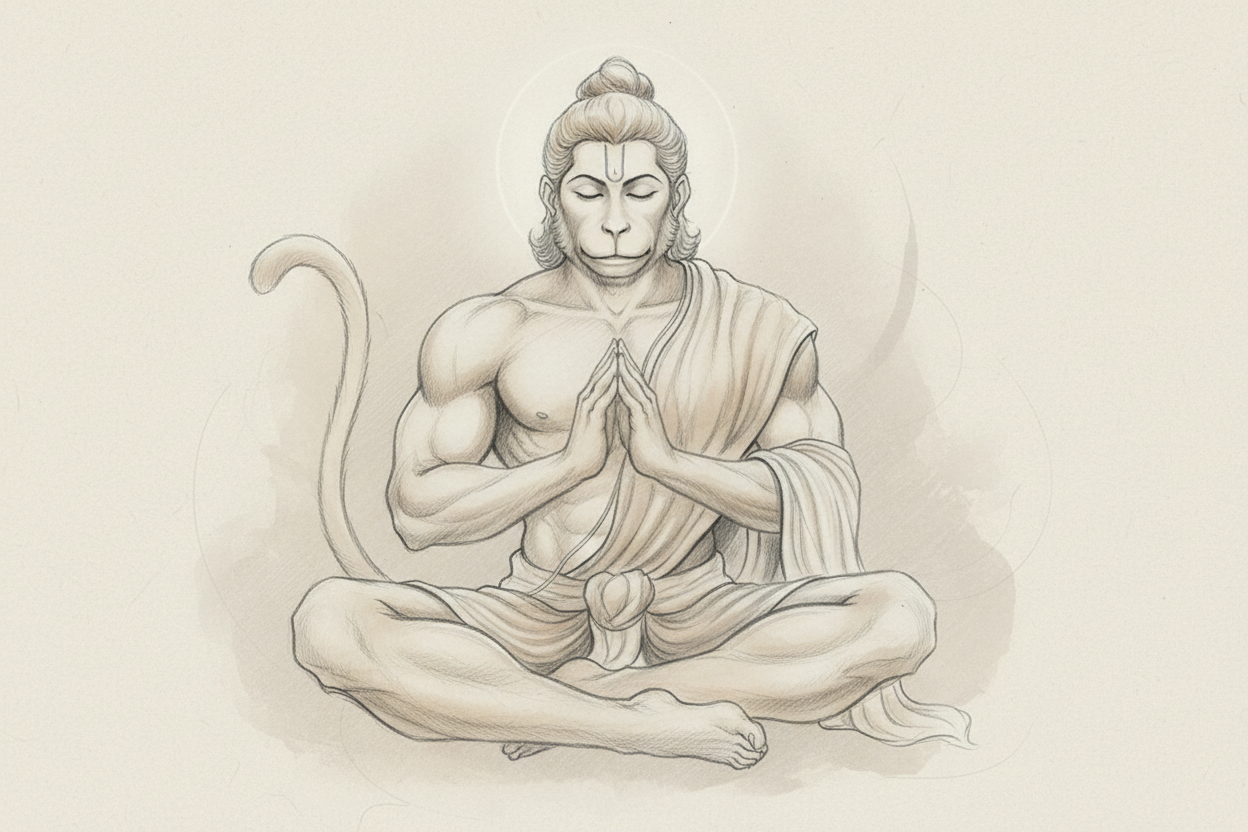
I didn't choose Hanuman. He chose me. Or more accurately, I only just realised he'd been there all along.
I had been using a chant in many of my classes. Playing a soothing version during savasana from a random playlist felt right for that long exhale at the end of practice, the moment when the body finally gives up its hold. I chose it because it felt right, because its sound had a quality that settled something.
It wasn't until recently that I looked more closely. The chant was for Hanuman.
The monkey deity. The one who carries devotion like a superpower, who crossed oceans in the service of love, who tore open his chest to reveal Ram and Sita living inside his heart, because his love was not something he wore. It was something he was built of.
What Hanuman means to me right now
I'm in a transitional period. And transitions have a particular kind of loneliness to them, even when they're the right ones. Even when you chose them.
For years, I brought everything I had to roles that ultimately served someone else's bottom line. The determination, the persistence, the ability to keep going when it would have been easier to stop, all of it converted into commissions and quarterly targets and other people's success.
I'm rewriting that reward system now. The reward is different: a rested body on a mat. A soothed nervous system. The particular look on someone's face when they've arrived, fully, into a moment of stillness they weren't sure they'd find. The cost and reward have been rewritten to expand my life, even if, for a time, they’ll shrink my bank account.
Hanuman is the deity I want by my side for this. He is the gentle nudge in the back seat of your ambition. The one who shows up after every setback, not with a speech, but with a quiet: you've got this. Keep reaching.
Reach bravely, consistently, and with courage, and he'll help you see your path unfold.
Why these stories belong in the yoga room
There is a reason the best yoga classes carry these stories. Not to impose religion on a wellness practice, but because the practice of yoga was never separate from these stories in the first place.
They are its spine.
And more than that, they work. Because when a teacher tells you that Hanuman leapt across an ocean in pure devotion, something in you recognises it. Not because you are Hanuman. But because you have been afraid to leap, and you have leapt anyway. Because you contain that story, too.
Every deity is a mirror. Every story is a map.
And the ones that move you? They're trying to show you something about yourself.