
Let me say upfront that I'm not entirely against biohacking. Some of it is genuinely interesting. Cold exposure has real research behind it. Sleep tracking can surface patterns that are hard to notice otherwise. Understanding your glucose response to food is useful information.
But there's something in the broader biohacking conversation that I keep coming back to, a premise so deeply embedded in the whole project that it rarely gets questioned: the idea that the body is a system to be optimised, and that with the right inputs, the right measurements, and the right protocols, you can engineer your way to a life that feels good.
That premise is where it starts to fall apart for me.
What biohacking is actually trying to solve
The appeal of biohacking makes complete sense once you understand what it's responding to. Most people who are drawn to it are exhausted, foggy, anxious, or running on empty. They feel like their body isn't working the way it should, and they want a solution. They want something concrete to do, something measurable, something that gives them a sense of control over a system that has felt out of control for a long time.
That's not a character flaw. That's a completely rational response to chronic stress, poor sleep, a depleted food system, and a culture that has systematically disconnected people from their own bodies while selling them ever more sophisticated tools to re-engage with them from the outside.
The problem isn't the desire to feel better. The problem is that biohacking, in most of its popular forms, addresses the output rather than the source.
What the nervous system actually needs
Here's what I've learned, slowly and sometimes the hard way: you cannot optimise a dysregulated nervous system. You can only regulate it.
Those are genuinely different things. Optimisation assumes a basically functional system that you're trying to make more efficient. Regulation assumes a system that has learned, through repeated experience, that the world isn't safe and needs to be patiently, consistently shown otherwise.
Stephen Porges' polyvagal theory describes this with real precision. The autonomic nervous system is always scanning the environment for signals of safety or threat, a process called neuroception, and it is doing this below the level of conscious awareness. When it has been chronically exposed to threat signals, whether from actual danger, relentless stress, or the low-grade activation of living in a state of constant urgency, it adapts. It stays alert. It keeps the body in a posture of readiness that was designed for short bursts, not as a permanent baseline.
No cold plunge fixes this. No peptide stack reaches it. No continuous glucose monitor tells you what your nervous system needs to feel safe. [Fight, Flight, Freeze or Fawn →]
What the nervous system needs is something much simpler and much harder to sell: repetition, consistency, presence, and time. Safety signals are repeated often enough that the body begins to believe them. [How to Build a Nervous System-Supportive Routine →]
The measurement problem
There's a particular irony in using external data to reconnect with your body. The whole premise of interoception, the body's ability to sense its own internal state, is that the information is already there, in the sensations of the body itself. Heartbeat, breath, hunger, temperature, tension, ease. Your body is generating this data constantly and communicating it to you directly.
When we layer external measurements on top of that, the risk is that we start trusting the device more than our own senses. We eat because the app says it's time, not because we're hungry. We push through a workout because the tracker says our recovery score is adequate, not because we actually feel recovered. We outsource the listening to technology, and the very faculty we were trying to develop, the ability to hear what our own body is telling us, gets bypassed rather than strengthened. [The Body as a Source of Emotional Intelligence →]
This isn't an argument against ever tracking anything. It's an argument for knowing what you're actually trying to build and making sure your tools are serving that goal rather than replacing it.
What works instead, and why it's harder to sell
The practices that genuinely regulate the nervous system are, almost without exception, free, slow, and require presence rather than purchase. They're also not very marketable because they don't have a before-and-after photo, they don't come in packaging, and their results aren't immediately measurable.
Breath is one of the most powerful regulators of the nervous system available to us, and it has been understood as such in yogic and contemplative traditions for thousands of years. A lengthened exhale activates the parasympathetic nervous system and can shift physiological arousal within seconds. Alternate nostril breathing balances the nervous system in ways that are now being measured and confirmed by research. None of this requires a device. [What Is Pranayama? →] [The Lengthened Exhale →]
Slow, rhythmic movement, yoga, walking, swimming, anything whole-body and unhurried, helps complete the stress cycle that chronic activation leaves unfinished. This is what Emily Nagoski's research on stress cycles makes clear: the body needs to move through the arc of activation and return to baseline, and it needs to do this regularly, not just occasionally. [Yoga as a Framework for Wholeness →]
Community, genuine human connection where the nervous system experiences co-regulation through another person's calm presence, is one of the oldest and most effective regulators we have. It also doesn't come in a subscription box.
Sleep, real sleep, not tracked and scored but actually prioritised and protected, is when the nervous system does its repair work. No supplement replaces it. [Why You Can't Switch Off at Night →]
What I'd ask instead of "how do I optimise this"
The question that biohacking tends to ask is: how do I make this system perform better?
The question I've found more useful is: what is this system trying to tell me, and have I been listening?
Because usually, when the body isn't performing the way we want it to, it isn't broken. It's communicating. The fatigue, the brain fog, the anxiety, the disrupted sleep: these are not malfunctions. They are messages. And the world's most sophisticated protocol won't translate them for you. Only slowing down enough to actually listen will do that.
That's not a very exciting sell. There's no device for it, no supplement stack, no thirty-day programme with a measurable outcome at the end. There's just the quiet, ongoing practice of paying attention to the one body you have, in the one life you're living, with the patience to let it tell you what it needs.
That, in my experience, is where the real change lives.
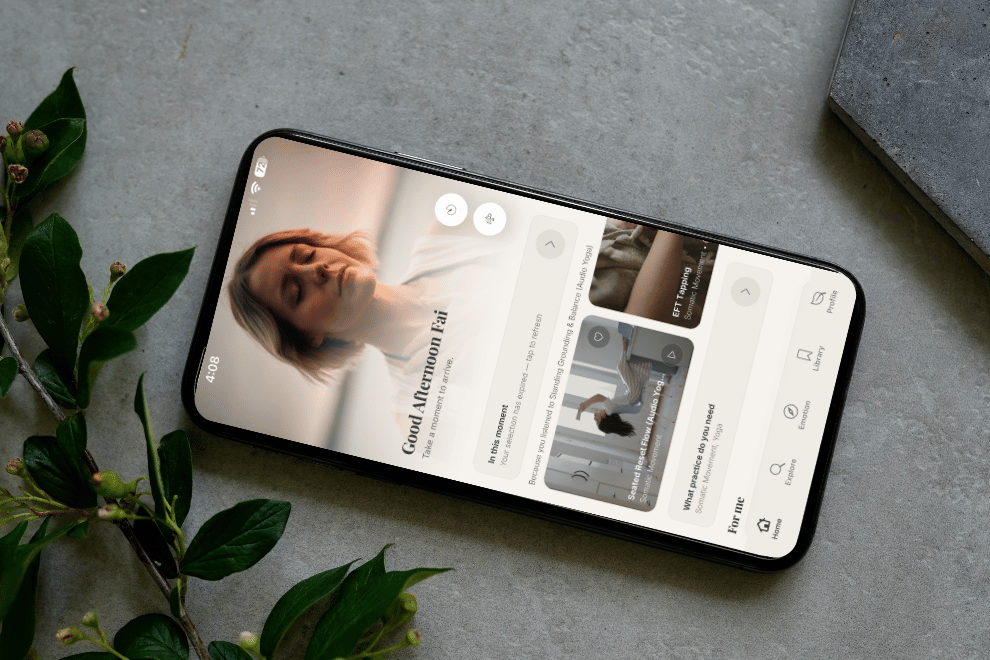
And if you're looking for somewhere to start, or somewhere to return to on the days when the noise gets loud again, that's exactly what the Contemplations app was built for. Not to track you, not to score you, not to optimise anything. Just to guide you back inward, through breath, meditation, and somatic practice, toward the part of you that already knows what it needs.
The most radical wellness technology available right now isn't wearable. It's you, paying attention. We're just here to help you practice.