
The instruction to calm down is one of the least useful things you can offer an anxious person. Including yourself. I say this not to be contrary, but because understanding why it doesn't work gets you much closer to what does. And what it comes down to is this: anxiety is not a thought. It's a body state. And you cannot think your way out of a body state.
If you've tried, and most of us have tried, often for years, you'll know the particular futility of telling yourself there's nothing to worry about while your heart is pounding and your thoughts are sprinting and your body is absolutely certain that something is wrong. The logic doesn't reach where the feeling lives.
What anxiety actually is
Anxiety is the nervous system's anticipatory threat response. Where fear is a response to something present and immediate, anxiety is the response to something possible, uncertain, or unresolved. The nervous system is running a predictive model of the future and finding threats, real or imagined, in the space between now and then.
Physiologically, anxiety is sympathetic nervous system activation: the same fight-or-flight cascade that would mobilise your body if you were in physical danger. Cortisol and adrenaline are released. Heart rate increases. Attention narrows. The digestive system slows. Muscles tense. Breathing becomes shallow and quick.
This response is not a mistake. In the context it was designed for, an actual physical threat requiring immediate action, it is extraordinarily effective. The problem is that the nervous system cannot reliably distinguish between a bear in the woods and an email from your manager with the subject line 'we need to talk'. The body responds to both with the same ancient mobilisation.
Why rational thought doesn't dissolve it
The prefrontal cortex, the part of the brain responsible for rational thought, long-term planning, and executive function, has significantly less influence over the amygdala, the brain's threat-detection centre, than we tend to assume.
Neuroscientist Joseph LeDoux spent decades researching fear circuitry and found that the amygdala's projections to the prefrontal cortex are stronger than the prefrontal cortex's projections back. In plain terms, the emotional, reactive brain speaks louder to the thinking brain than the thinking brain speaks back. Which is why reassuring yourself doesn't always reassure you.
This isn't to say thinking is useless; over time and with practice, cognitive approaches to anxiety can be genuinely helpful. But in the moment of acute activation, trying to reason yourself calm is often fighting the current. The body needs to be addressed in the body's language.
What actually helps in the moment
Because anxiety is a physiological state, the most reliable routes out of it are physiological. The nervous system needs information, sensory, somatic information, that the present moment is safe.
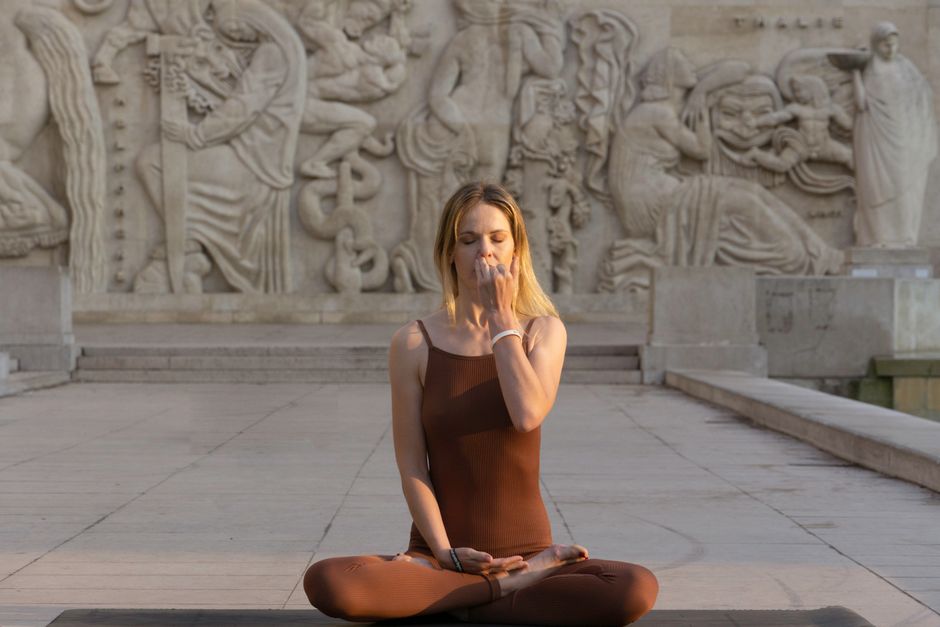
The breath is the most direct lever available to most people. A deliberately extended exhale, longer than the inhale, activates the parasympathetic nervous system, the branch responsible for rest and recovery. You don't need a formal practice for this. You just need to breathe out for longer than you breathe in, a few times, with attention.
The physiological sigh, a double inhale through the nose followed by a long, slow exhale through the mouth, is particularly effective and can produce a measurable shift in physiological arousal within a few breath cycles. Neuroscientist Andrew Huberman's research has highlighted this as one of the fastest-acting, real-time anxiety-reduction tools available without any equipment or training.
Grounding practices that engage the senses, touching something textured, looking around and naming what you see, putting your feet flat on the floor and feeling the ground beneath them, also work by providing present-moment safety information to the nervous system. The message is: you are here, not in the imagined future. The threat you're responding to hasn't happened yet.
What helps over time
Consistently building nervous system capacity, through regular movement, breath practice, adequate sleep, reduced chronic stress load, and the regular experience of settling after activation, changes the baseline from which anxiety arises. Not eliminating it, but raising the threshold.
Therapy, particularly somatic approaches that work with the body's experience of anxiety rather than purely the thoughts around it, can be transformative for people whose anxiety patterns are longstanding or significantly interfering with daily life.
And perhaps most practically: becoming familiar with your own anxiety patterns. Learning what the early signals look like in your body, the particular quality of tension, the first sign of breath change, the thought pattern that appears early, means you can intervene earlier, when the physiological arousal is lower and easier to shift, rather than waiting until you're fully activated and the rational mind has gone offline.
Anxiety is not something to be ashamed of, and it is not evidence that you are weak or broken. It is the nervous system doing something ancient and intelligent, in a context that has changed faster than evolution can keep up with. Understanding that doesn't fix it. But it does, quietly, change the way you hold it.